October 24, 2026
RTX 5080 24GB and the 16GB Tier: A 2027 Price Forecast
hardware · AI hardware · GPUs · GPU pricing · local AI · capacity planning
On 10 October 2026 a factory notice spread through the hardware press. Nvidia, it said, would stop building GeForce RTX 5090 cards. The GB202 chips behind them would go to data center and professional boards instead. The new top GeForce would be a 24GB RTX 5080.
Six days later, Nvidia’s Jeff Fisher stood on a stage in Taipei and said the opposite. The RTX 5090 “has definitely not been discontinued,” he said. Shipments continue.
Both statements can be true at the same time. A product can stay on a price list while the chips and memory behind it go somewhere else. That gap is the story here. It is also what decides the price of every card below the flagship.
This piece does three things. It separates what is confirmed from what is reported. It follows the memory math down to the board. And it states my forecast in plain terms: a 16GB RTX 5070 Ti will not sell below $2,000 during 2027. I am not certain. The conditions that would prove me wrong are specific, and I list them at the end.
What Is Confirmed and What Is Reported
Most coverage turned this into one headline about a dead card. The claim underneath was narrower.
| Claim | Status |
|---|---|
| GB202 dies no longer allocated to board partners for consumer cards | Reported from a leaked factory notice. No confirmation from Nvidia |
| The RTX 5090 is discontinued | Denied on 16 October 2026. Fisher acknowledged constrained capacity |
| A 24GB RTX 5080 replacing the 16GB model | Reported for Q1 2027 by BenchLife. Board partners have no development documentation, only a verbal notice |
| Street price of the RTX 5090 | Measurable: $8,500 to $9,300 against a $1,999 MSRP |
BenchLife’s own wording matters. What happened looks like an internal production decision, not a formal product discontinuation.
Retail signals point the same way. Micro Center lists the card as “Not Carried.” One B&H customer was told that a waitlisted order had been marked discontinued. Nvidia’s position and the channel’s position are not the same thing. The channel is where prices get set.
Two Resources, One Margin Problem
AI memory does not have its own factory line. The same three companies control the DRAM that feeds graphics cards. They have simply moved that capacity toward whatever earns more per wafer.
The numbers show why. High-bandwidth memory, the kind inside AI accelerators, uses about three times more silicon per gigabyte than DDR5. It now takes about 23% of all DRAM output, up from 19% the year before. One HBM stack sells for $60 to $100. The same amount of ordinary DRAM sells for $5 to $10.
Consumer graphics memory competes inside that same pool. GDDR7 comes from the same three suppliers. Fixed-price contracts protected card makers until the end of 2025. Those contracts expired. Now board partners buy memory at market price, and Nvidia has raised the price of the memory kits it bundles with GeForce cards.
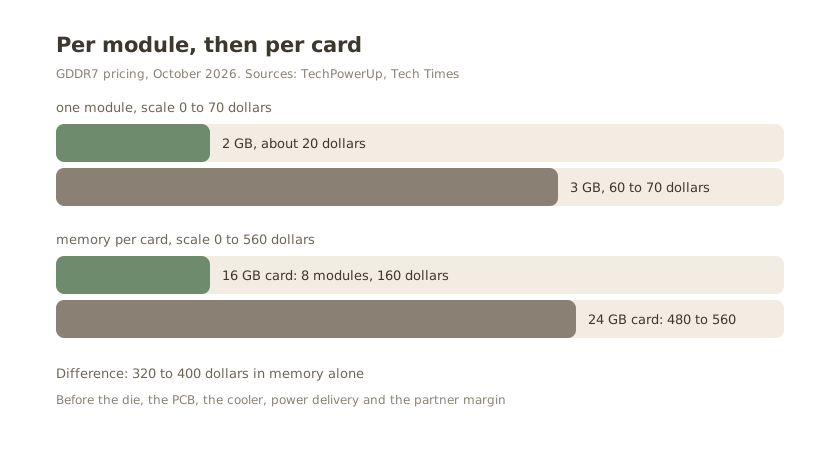
At board level the difference is density. A 2GB GDDR7 module costs about $20. A 3GB module costs $60 to $70. The current 16GB RTX 5080 uses eight 2GB modules, so its memory costs about $160. A 24GB card needs eight 3GB modules, which is $480 to $560.
That is $320 to $400 of extra cost before the die, the PCB, the cooler and the partner’s margin. Memory is no longer a small line item inside a card. It is the biggest part of the decision.
Bandwidth Is Equal, Capacity Is the Gate
The price gap between the 5070 Ti and the 5080 is not about speed.
The 5070 Ti runs a 256-bit bus at 28 Gbps, which is 896 GB/s. The 5080 runs the same bus at 30 Gbps, which is 960 GB/s. That is a 7% difference. The rumored 24GB model keeps the bus and moves to 32 Gbps, landing near 1,024 GB/s, with the same core count. What changes on the shelf is capacity, not speed.
Two different questions hide behind that number. Capacity decides whether a model and its key-value cache fit on the card. Bandwidth decides how fast the data moves once it is there. A 32-billion-parameter model at 4-bit lands around 18 to 20GB loaded. On a 16GB card it spills into system memory, and throughput collapses. That is the whole 16GB ceiling in one sentence.
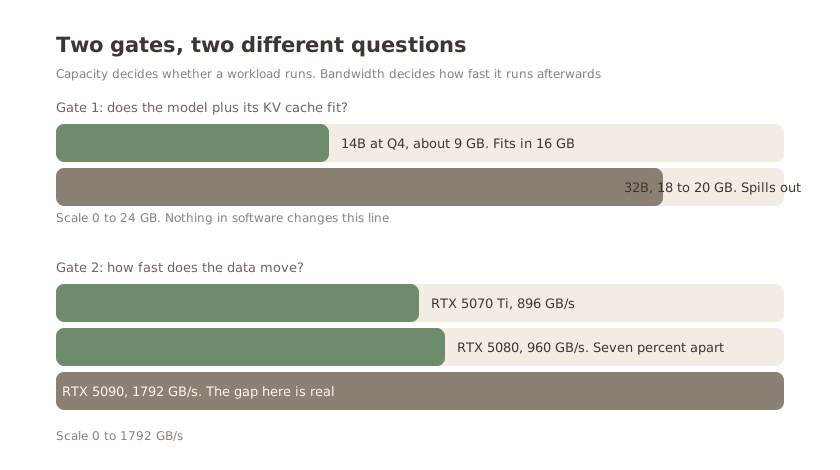
So the tier line moves to the question a buyer actually cares about. For agent workloads, the gate is capacity and context length. That is why a 24GB card on the same silicon can become the most valuable card in the consumer stack.
Why the Used 3090 Is No Longer the Right Comparator
On capacity alone, the used market still wins. A 24GB RTX 3090 gives you 936 GB/s for $1,200 to $1,400. That is nearly the bandwidth of a 5070 Ti. For a workload that fits inside 24GB at 4-bit, the older card is the cheaper answer. It has been the value anchor here for two years.
The comparison breaks on architecture. Ampere’s third-generation tensor cores support TF32, BF16, INT8 and INT4. They do not support FP8. NVFP4 belongs to Blackwell alone. On Ada and Ampere, FP4 runs as emulated kernels at higher precision, which brings no latency advantage over BF16.
Training is the other half of the same gap. FP8 training and NVFP4 both need tensor cores that Ampere does not have. So a 3090 stays an inference card with a narrow fine-tuning path. Reading weights is fine. Updating them is the wrong job for it, whatever the gigabytes say.
Precision also changes what a small card can hold. Measured deployments on consumer Blackwell cards show FP8 key-value cache quantization opening 32k to 64k context lengths on 16GB cards that would otherwise be stuck with shorter contexts. Quantization on an older card saves memory. On a Blackwell card, low precision plus cache management saves memory and keeps the context long. Agent workloads live on long context.
So the price premium is justified for one buyer and not for the other. If you run a 14B model at 4-bit with a short context, a used 3090 serves you better. That buyer sets the ceiling on what a new 16GB card can charge. My forecast depends on which of these two buyers dominates the tier in 2027.
Where $2,000 Comes From
The ladder pulls in both directions. The top of the stack sets the ceiling. The used market sets the floor. The tier between them settles at whichever force is stronger.
| Tier | Capacity | FP4/FP8 | Bandwidth | Price now | What determines it |
|---|---|---|---|---|---|
| Used RTX 3090 | 24GB | No | 936 GB/s | $1,200 to $1,400 | Value anchor for inference |
| RTX 5070 Ti 16GB | 16GB | Yes | 896 GB/s | $1,100 to $1,250 median, listings near $2,000 | Cheapest entry to Blackwell, plus scarcity |
| RTX 5080 24GB | 24GB | Yes | near 1,024 GB/s | No price announced. Estimates from $1,300 to $3,000 | Pricing power with no flagship above it |
Three forces hold the 16GB tier up.
Cost is the first. Memory alone adds $320 to $400, and the same inflation reaches the 16GB cards.
Scarcity is the second, and it is already working. Asus’s graphics division put the 5070 Ti into end-of-life status in January 2026. Distributors report they cannot source stock.
Tier collapse is the third. Once 24GB becomes the entry point for low precision and long context, 16GB stops being an AI card. It becomes a gaming card.
One thing follows from that. Value per gigabyte falls while the price rises. That sounds like a contradiction. It is not. It is what a shrinking supply does to a tier that has lost its reason to exist but still has buyers.
Efficiency Does Not Reduce Hardware Demand
Models need fewer bytes per token every year. The number of machines never goes down because of it.
Jevons’ paradox names the mechanism. When a resource gets cheaper to use per unit of work, total consumption rises instead of falling. Road transport is the measured example. A 1% improvement in fuel efficiency produced a 1.2% increase in miles traveled. The rebound is above 100%, which is when the paradox actually holds. Cars got more economical. They never got slower.
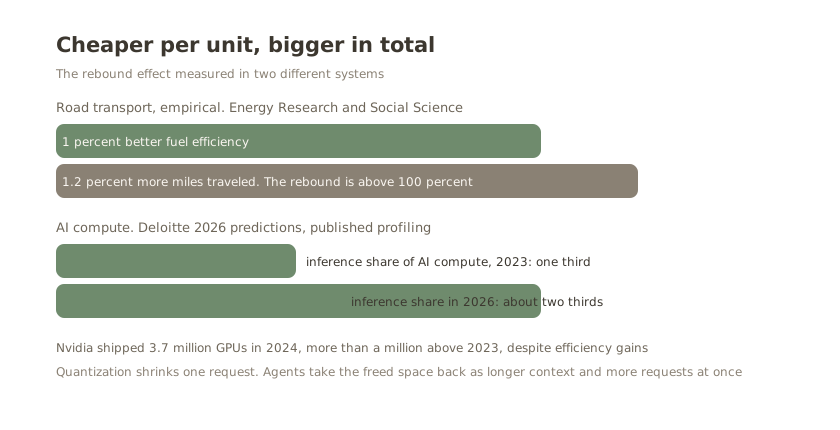
Compute behaves the same way. Nvidia shipped 3.7 million GPUs in 2024, more than a million above 2023, despite better efficiency each year. Deloitte expects compute demand to keep growing at four to five times per year through 2030, faster than chips get more efficient. Inference now takes about two thirds of all AI compute. In 2023 it was one third. Quantization shrinks one request. Agents take the space back with longer contexts and more requests at once.
For a buyer this is the practical part. Better quantization does not make a 16GB card enough. It makes a 16GB card do more jobs at once. That is why the price does not fall when the model gets smaller. The efficiency curve points down. The price curve points up. The price curve wins, because it is tied to supply and not to software.
My Forecast for 2027, and Where I Am Wrong
Through 2027, a 16GB RTX 5070 Ti will not sell below $2,000 in the United States.
Not because the card got better. Bandwidth was never the differentiator here. Capacity is, and that gate is closing while the supply of this tier is already cut.
I put my confidence at 60 to 70%. The strongest part of the bet is that the card is no longer produced. A fixed pool of stock, facing demand that efficiency gains cannot shrink, does not behave like a normal product price. It behaves like a collectible that still works.
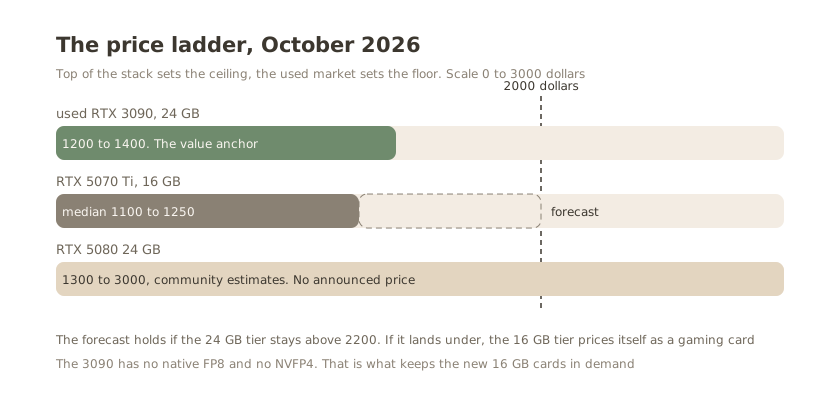
You can check me in 2027. Look at completed sales for 16GB Blackwell cards. Do not look at asking prices. Those already reach $2,000, and an asking price is weaker evidence than money that actually changed hands.
Two things would prove me wrong.
If a 24GB card lands under $2,200, the 16GB tier loses its reason to exist as an AI card. It prices itself as a gaming card, and gaming cards fall.
If consumer demand breaks, the floor can hold while the median stays under it. Those are two different numbers.
Neither condition is hypothetical. Memory price growth slowed to 13 to 18% quarter over quarter in the third quarter of 2026, as buyers hit an affordability wall. Gartner flags a double-digit decline in PC shipments for 2026. Supply relief is not expected before 2027 or 2028. SK Hynix has warned the shortage could run past 2030.
If I am wrong, the second condition will probably arrive first.
What to Do If You Are Buying Now
Decide by workload, not by tier name.
Start with your own footprint. Take the model weights at the quantization you intend to run. Add the context length you actually need. Add overhead. A 14B model at 4-bit with an 8k context fits inside 16GB with room to spare. A 32B model does not fit at all. No software optimization changes that line.
Then match the answer to the work.
- If your workload fits inside 16GB today, the used 24GB market is still better value. There is no urgency. Paying $2,000 for a card you have already outgrown is the wrong order of operations.
- If your workload needs long context and low precision, you are buying an architecture, not gigabytes. The 16GB tier is the cheapest way in. Its price is set by scarcity, not by performance.
- If you are planning a small fleet instead of one machine, the math changes. Agent workloads are mostly orchestration. The next wave of the chip shortage is about the CPU, not the GPU. In published profiling, a strong processor with a modest card matched a top-tier GPU end to end. The memory-bound decode stage is also where custom silicon separates from general GPUs. Sizing the work costs less than buying the card.
Here is the through-line. Nvidia is not raising prices because these cards got faster. It is pricing capacity, because capacity is the resource it can no longer spare for gamers. A 16GB card in 2027 gets sold to two kinds of people: those whose work no longer fits in 16GB, and those who cannot reach the tier above. Both pay the same memory tax.
If your build sits on this boundary, I would rather walk through the numbers than guess. Send me the workload and the context length. I will tell you whether 16GB is enough.
Frequently Asked Questions
Is the RTX 5090 discontinued?
Not officially. Nvidia denied it on 16 October 2026. What is reported is different: GB202 dies are no longer allocated to consumer board partners. That is a production decision, not a product announcement. Street prices of $8,500 to $9,300 against a $1,999 launch MSRP show how far the two can drift apart.
When does the RTX 5080 24GB arrive, and what will it cost?
Q1 2027 is the reported window, and board partners have only a verbal notice so far. It would replace the 16GB model rather than sit beside it. No price is announced. Public estimates run from about $1,300 to $3,000. The card was previously known as the RTX 5080 SUPER, and it was put on hold over 3GB GDDR7 module pricing. Treat the date as unsettled.
Why is a card with no performance gain getting more expensive?
Its memory got more expensive and its production stopped. That is cost pass-through, not value added. A 3GB module at $60 to $70 against a 2GB module at $20 explains it at the bill-of-materials level.
Is a used RTX 3090 better than a new RTX 5070 Ti for local AI?
For inference that fits in 24GB at 4-bit, yes, and it costs less. The 3090 has no native FP8 and no NVFP4. It cannot use the low-precision cache paths that make long context practical on a smaller card. For fine-tuning and training it is the wrong tool. The answer depends on whether your work needs gigabytes or hardware support for low precision.
Will GPU prices fall in 2027?
The supply answer to a memory shortage arrives in years, not quarters. New fab capacity is not expected in volume before 2027. Consumer demand is already at an affordability limit. Plan for prices holding, not falling.
Does 16GB still make sense for local models in 2026?
Yes for 7B to 14B models with a modest context. No for 32B and above. The ceiling is the model plus its cache, not the driver.